Each fixture architecture trades off actuation force, probe count and operator ergonomics. Here is how our engineers help customers decide.
A test fixture is only as good as its fit for the board under test. Before quoting a kit, we look at three things: how many test points need to be contacted, how much force the probes require in total, and how the operator will load and unload the unit under test (UUT).
Those three questions narrow the field quickly. A board with 40 test points on one side and a few hundred units a month has very different needs from a double-sided board with 900 nets running two shifts a day. Below we walk through the three kit families we build most often, where each one shines, and the questions we ask before recommending one.
Start with the numbers
Total probe force is the figure that drives most decisions. A typical 100-mil spring probe needs between 4 and 8 ounces of force at working travel.
- Count every test point.
- Choose a probe series.
- Multiply to get total force.
- Compare the result to the comfortable range of each actuation type.
As a rule of thumb, hand-lever kits stay comfortable up to roughly 60 lbs of total force. Beyond that, operators tire over a shift and contact consistency starts to suffer. That is where mechanical presses and pneumatic actuation come in.
Z-Axis fixture kits
Z-Axis kits drive the top plate straight down, keeping the pressure plate parallel to the PCB throughout the stroke.
- Best for high probe counts
- Parallel actuation protects fine-pitch components
- Pairs well with vacuum or pneumatic upgrades
When Z-Axis is overkill
For a small single-sided board with a few dozen test points, a Z-Axis kit adds cost and footprint without improving contact. If the probe field is small and centered, a clamshell will usually give you the same first-pass yield for less.
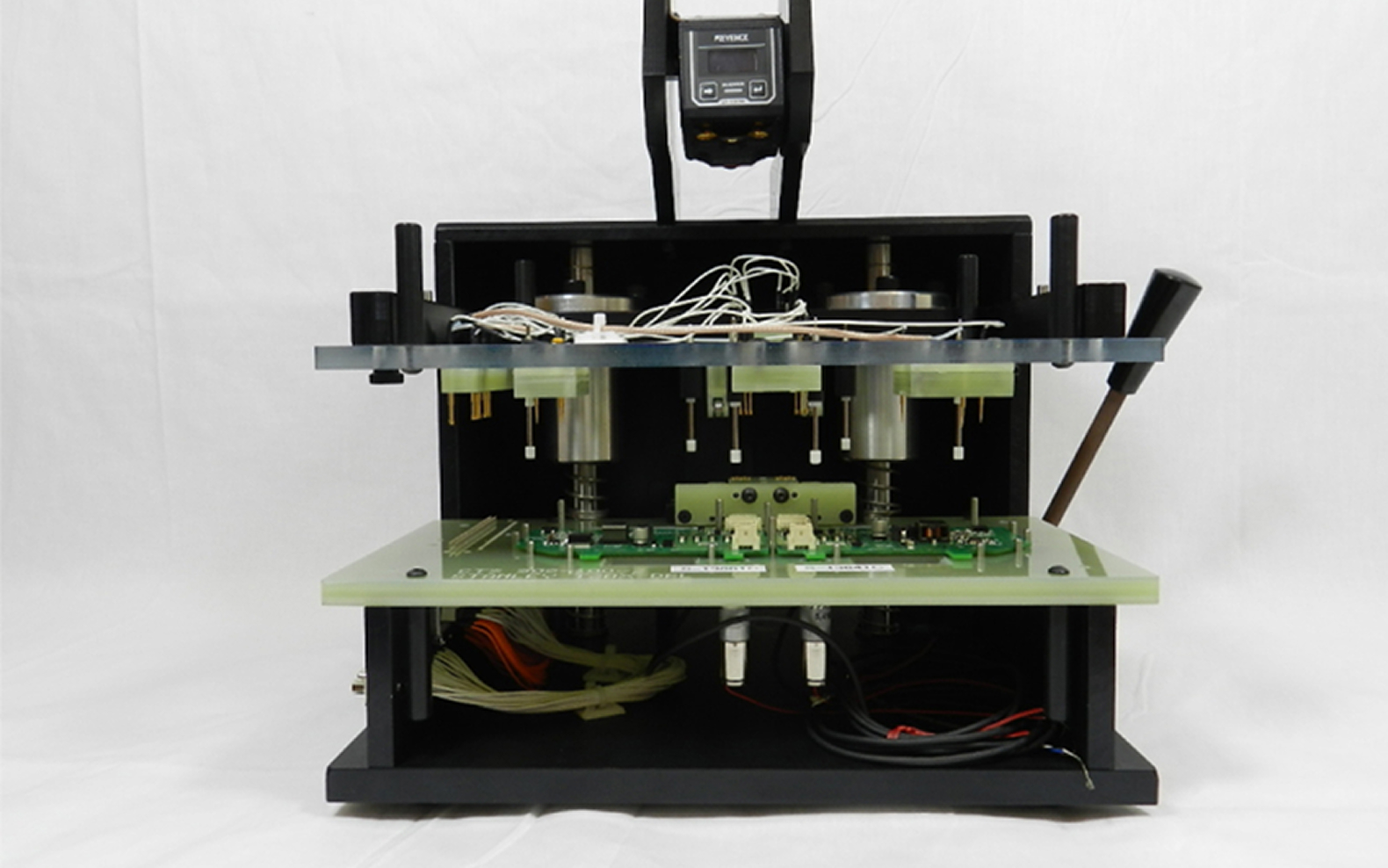
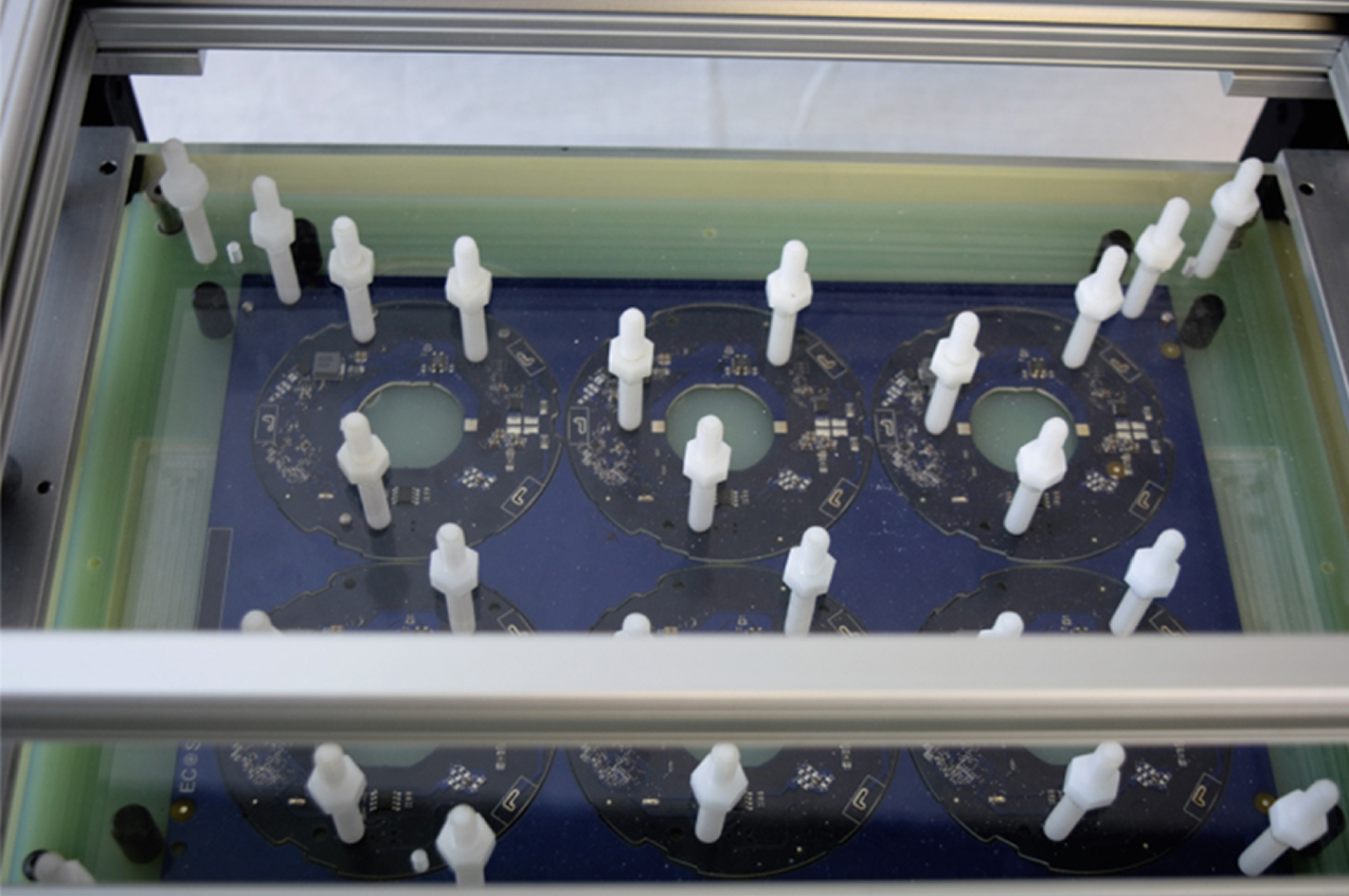
A pneumatic Z-Axis kit configured for a double-sided power board.
Clamshell fixture kits
Clamshell kits hinge the lid like a book. They are compact, quick to load and cost-effective for low-to-medium probe counts — ideal for engineering validation and lower-volume production lines.
Because the lid travels in an arc, the pressure plate meets the board at a slight angle before seating. On most boards that is harmless, but tall connectors near the hinge side can get in the way. We check component heights against the lid path during design so there are no surprises at first article.
- Best for: prototypes, low-to-medium volumes, single-sided boards
- Smallest footprint of the three kit families
- Fast changeover with swappable probe plates
Mechanical press fixture kits
When you need more actuation force than a hand lever comfortably provides, a mechanical press adds leverage while keeping the fixture fully manual. No compressed air, no electrical actuation — just a robust, repeatable stroke.
Presses are popular on lines where shop air is not available at the test bench, or where the customer wants to avoid the maintenance of pneumatic cylinders and regulators. The trade-off is a taller fixture and a slightly slower cycle compared with a pneumatic kit.
“The cheapest fixture is the one you only have to build once. Matching the architecture to the board up front saves rework later.”
— Cortek Applications Engineering
Questions we ask before quoting
- How many units per shift, and how many shifts per day?
- Is the board tested on one side or both?
- Will the fixture connect to an in-circuit tester, a functional tester or both?
- Is compressed air available at the test station?
- Are there tall or fragile components near the probe field?
- Do you expect board revisions that will move test points?
Not sure which kit fits your board? Send us your Gerber files and test point list and our team will recommend a configuration within two business days.